The Silence of the Lambs.
The Alhambra Theatre.

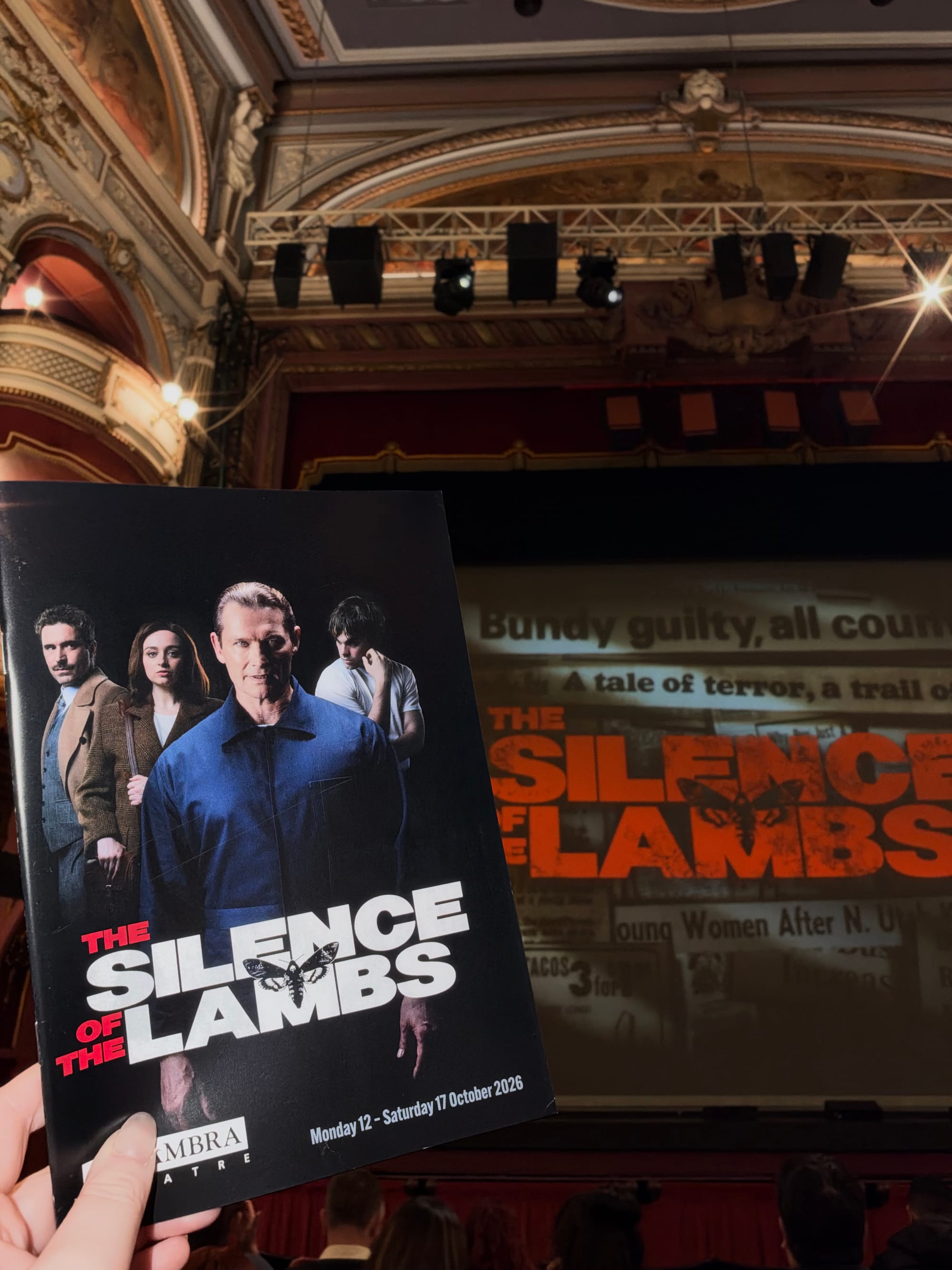
This week, I headed to the Alhambra Theatre in Bradford for press night of The Silence of the Lambs. A huge thank you to Emma for the invite.
I have covered a lot of adaptations from book page to stage, but I was particularly interested to see how this one would translate. Thomas Harris' book is incredibly well known, but for many people, The Silence of the Lambs is even more closely associated with the iconic film starring Anthony Hopkins and Jodie Foster.
When adapting something so familiar for the stage, there will always be critiques from audiences. Stay too close to the film and people may question what the stage version brings to the story, but move too far away from the source and you risk losing what people loved about it in the first place. With characters as recognisable as Clarice Starling and Hannibal Lecter, it was always going to be a difficult balance.
The story follows FBI trainee Clarice Starling (Mollie Gallagher), who becomes involved in the hunt for serial killer Jame Gumb, better known as Buffalo Bill (Sam Jackson). As part of the investigation, Clarice is sent to speak to imprisoned psychiatrist and murderer Dr Hannibal Lecter (John Partridge), in the hope that his understanding of criminal behaviour might help them find the killer.
Lecter quickly realises that Clarice has not simply been sent to ask him questions and turns their conversations into an exchange. He will offer his insight, but only if Clarice gives him something personal in return. As their conversations become increasingly intimate, an unusual relationship begins to develop between them.
It is almost impossible not to compare this production with the film. Jonathan Demme's screen adaptation makes extraordinary use of close-ups, allowing us to see every tiny expression and reaction, particularly during the scenes between Clarice and Lecter. The camera can linger on a stare for just a little too long, gradually building that uncomfortable sense of unease. Theatre cannot rely on that same intimacy, particularly on a stage as large as the Alhambra, so the production has to find different ways of creating that tension.
Mollie Gallagher gives a self-assured performance as Clarice, capturing both her determination and the youthful confidence of an FBI trainee desperate to prove herself. She fully commits to Clarice's infamous accent. Considering this is a professional stage debut, it is an impressive introduction and she carries a demanding central role with confidence.
Opposite her, John Partridge brings a very different energy to Hannibal Lecter. His portrayal is confident, arrogant and undeniably sadistic, but he does not simply try to recreate Anthony Hopkins' iconic performance. I appreciated the distinct approach he brought to the character, and his experience on stage is clear throughout. His scenes with Gallagher often feel like a battle for control, with Lecter constantly testing how far he can push Clarice. However, his standout moment has to be the infamous scene involving the guard. I genuinely found myself laughing out of sheer anxiety at what I was watching. When people talk about an Oscar-worthy performance, this is exactly what I imagine. The combination of Partridge's acting, the lighting and the sound made the entire sequence almost unbearable to watch, yet I simply could not look away. It was easily one of the most memorable moments of the production.
Sam Jackson is equally convincing as Buffalo Bill. He moves between an apparently innocent young man and someone deeply disturbed with ease, making the contrast between the two sides of the character believable. His sudden changes in temperament make him unpredictable, with his more volatile moments bringing a completely different energy to the production. His standout moment comes just before the end of the first act, when we see his creation come to life on his own body. What made his performance even more unsettling was how his character remained present throughout the second act, often just outside the focus of the main action on stage, continuing to work on his skin coat. Knowing he was there, even when the attention was elsewhere, added another layer of uneasiness to the production. It was an effective way of keeping Buffalo Bill's disturbing activities in the audience's mind without making him the centre of every scene.
For me, though, it was Lottie Amor as Catherine Martin who really stole the show. She is completely believable as a young woman being held captive, and every emotion, from fear and sadness to anger, distress and desperation, feels genuine. There were moments when her performance was genuinely uncomfortable to watch because of how convincing she was, and I found myself completely drawn into Catherine's situation.
Alongside the performances, one of the biggest strengths of The Silence of the Lambs is its set. The entire design is jaw-dropping.
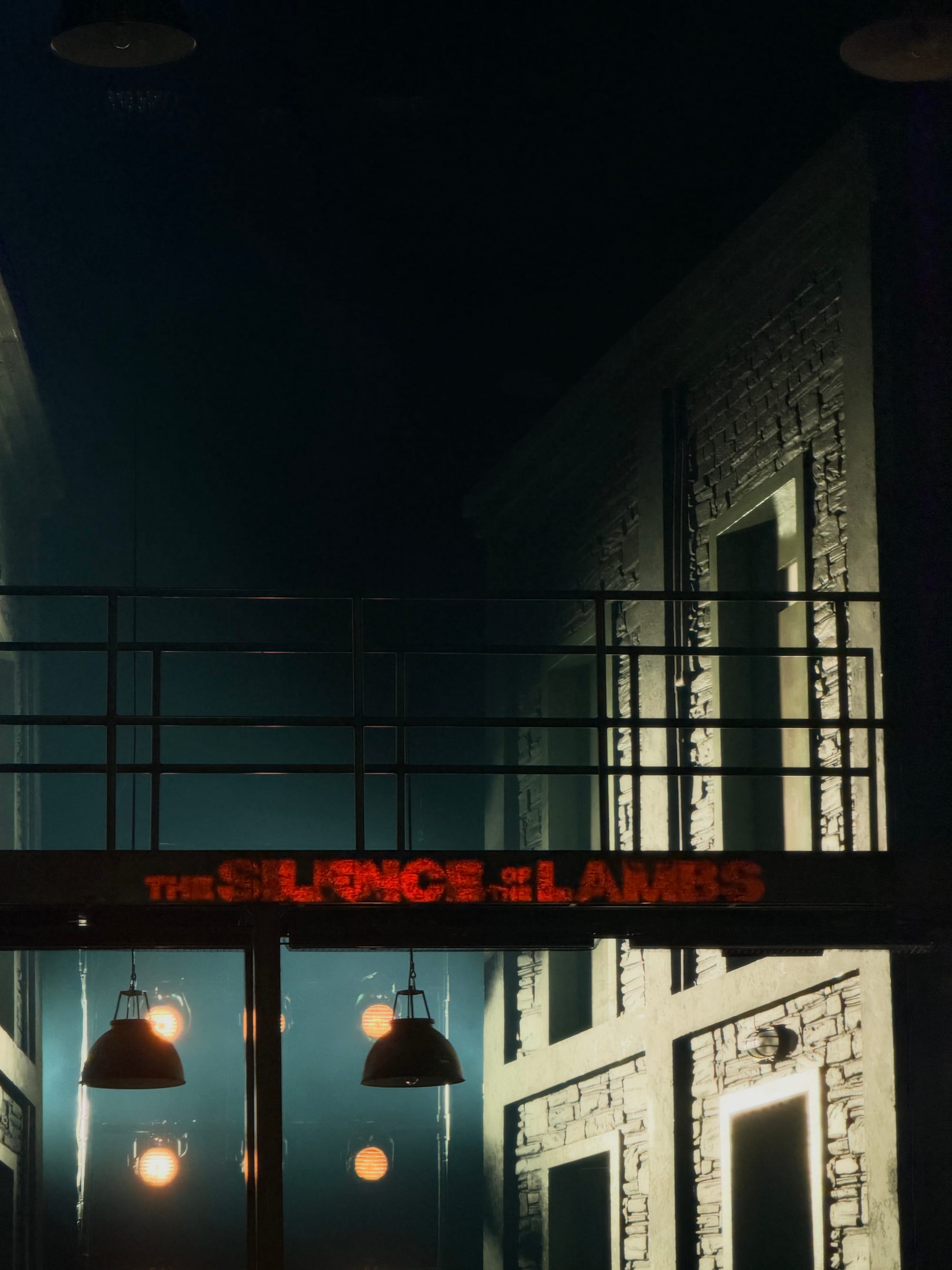
The stage is dominated by a huge structure filled with different levels, corridors, doors and hidden spaces. One moment we are inside a secure institution with Lecter in his cell and, before you know it, the same space has transformed into a motel corridor or somewhere completely different.
The speed at which these changes happen is incredibly impressive. Rather than stopping the action for lengthy scene changes, different areas of the set are revealed and reused, allowing the story to keep moving. Lecter's glass cell is particularly effective, creating a contained space for his conversations with Clarice while still allowing the rest of the stage to remain active around them.
At several points, different parts of the story unfold at the same time, which gives the production an almost cinematic quality without making it feel as though it is simply trying to recreate the film.
Lighting, sound and projections add even more to the atmosphere. There are moments when the stage feels enormous and others when it suddenly becomes claustrophobic. Doors open onto spaces you were not expecting, characters appear from the darkness and there is often a feeling that something is happening just beyond what you can see. Technically and visually, this production is seriously impressive, and it is through its staging that The Silence of the Lambs really finds its own identity.
What made the evening even more interesting for me was that my husband went into The Silence of the Lambs completely blind. He had never read the book or seen the film, so while I was inevitably making comparisons with a story I already knew, he had none of those expectations. He came out genuinely amazed by what we had just watched, particularly the staging and the way the story unfolded, although I suspect he may have come away with a touch of PTSD from that infamous guard scene! I loved having those two very different perspectives afterwards, and I think his reaction says a lot about how well the production works for audiences who are discovering The Silence of the Lambs for the first time.
I went into the theatre wondering whether a story so closely associated with film could work on stage, especially when so much of its tension comes from quiet conversations and tiny reactions. Theatre inevitably has to approach that tension differently, and this production does. It is bigger, more physical and more theatrical, while still keeping the psychological game between Clarice and Lecter at its centre.
For something I thought would be incredibly difficult to move from page, to screen, to stage, I was surprised by just how naturally it works.
The Silence of the Lambs is at the Alhambra Theatre, Bradford from the 12th to 17th of October 2026. You can purchase tickets here.